

Bringing former armed services personnel into the construction industry could be key to building the 1.5m houses we need; it would also help them build a new life after serving, writes John Leary from Lovell
There’s no getting away from the fact we need to build more homes.
A recent study, commissioned by the National Housing Federation (NHF) and Crisis from Heriot-Watt University stated that we need to build 340,000 new homes each year to meet demand, of which 145,000 need to be truly affordable.
Further to this, the Housing, Communities & Local Government Select Committee said there was “compelling evidence that England needs at least 90,000 net additional social homes a year”.
Yet, collectively as an industry, we haven’t been able to build the homes needed for a variety of different reasons. For example, at a low point in 2012/13, just 125,000 new homes were built. It’s been rising since then – despite a slight dip during the pandemic – to a high point in 2019/20 of 243,000.
For social rent homes, before 2011, the majority of new affordable homes were made for social rent, but by 2022/23, this fell to a low of just 15%. It’s expected that 33,350 social homes will be made available up to 2026 as part of the Affordable Homes Programme.

While there’s consensus that we need homes, particularly social rent and affordable homes, solving Britain’s chronic housing shortage means it’s not just about the physical dwellings, but also about being able to actually construct them.
According to the Construction Industry Training Board, we need more than 250,000 new construction workers by 2028 if we are to meet the demand for housing over the next five years.
Data from Randstad UK found the construction labour force has significantly shrunk in recent years; from 2.6 million people in 2008 to 2.1 million people in 2023. That means we need innovative thinking, and innovative solutions, in order to grow the workforce and grow it from all sections of society.
Veteran solution
Could veterans play a key role? We certainly think so.
Harnessing the skills, life experience and contributions from some of our valued former Services personnel could hold one of the keys to getting the spades in the ground that we need.
With the right support, training and mentorship, those interested could support the industry in providing safe and comfortable homes for millions of people who are currently languishing on waiting lists, or otherwise keen for their own place.
Lovell has held a strong affiliation with the armed forces for a number of years, having been a proud signatory to the Armed Forces Covenant, and having worked on several, key service family accommodation schemes for the Ministry of Defence over the past 20 years.
For example, we played a pivotal role in Project BORONA, which saw the creation of 346 Service family homes in record time at the Beacon Barracks in Stafford, for families who were relocating in connection with the Army Basing Programme (ABP).
Also, we delivered 917 service family homes on Salisbury Plain, as part of the ABP, to ensure there were homes ready for families returning from bases in Germany. These key schemes saw Lovell fully embrace the military family and leave a positive legacy within the veterans’ community.
We have also pioneered initiatives such as the Veteran Build Experiences programme, where we hired former Services personnel to develop new skills in construction and secure an affordable new home. Each one faced homelessness before being taken on but were keen for a chance, so they received a bespoke package of support, with the aim of a fruitful, long-lasting career in construction.
Over the past few weeks, we’ve extended our commitment further through our national corporate partnership with Building Heroes. The charity provides skills training to military veterans and supports them into employment in the building trades.
By working with Building Heroes, we are going to provide our valued veterans on-site immersive training opportunities, with exposure to on-site activities and site safety requirements, new skills development, industry awareness through site interventions and employer insight sessions, and dedicated industry days.
Our industry presents a fantastic opportunity to give veterans the chance at a second career, while helping to alleviate some of the pressures that exist around housing and the construction skills shortage.
Veterans are deeply embedded in our missions and how we see housebuilding going forward. We want to make those connections last longer, become more impactful and show up and down the country how we’re making a difference to this community.
We know we can build something positive in housebuilding for our former Services personnel. We can show them to the wide ranging opportunities of a career in our industry, that they can be proud of and know that they are coming to the aid of millions of people who simply want a safe place to live.
So, by working together with partners, we hope to build on our shared commitments, values and vision by offering opportunities to veterans in whatever way we can… it’s the Lovell Way.
John Leary is major projects director at Lovell
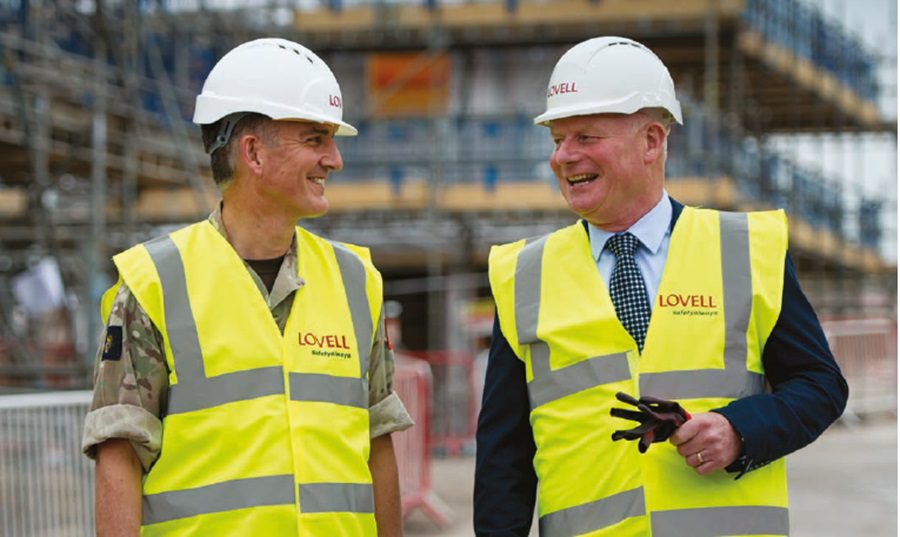
Main image: (Left to right) Lieutenant General (Ret’d) Sir Nicholas Pope, KCB, CBE, and John Leary, major projects director, Lovell
Read next: Biodiversity project hailed as a success as hundreds more sites on the way
Are you a social housing professional? Sign up for a FREE MEMBERSHIP to upload news stories, post job vacancies, and connect with colleagues on our secure social feed.
