


New Ordnance Survey research links overheating cities to housing, with deprived areas among the worst exposed as the built environment struggles to cope with a warming climate
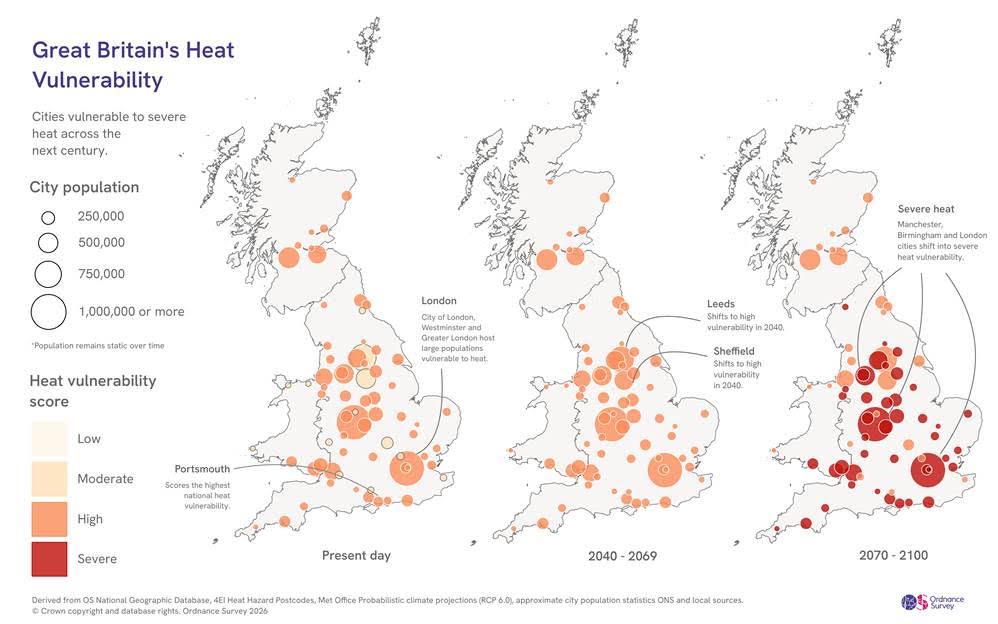
Almost two thirds of British cities will reach severe heat vulnerability by 2070, an Ordnance Survey (OS) study has found, with obvious implications for house building.
The OS Heat Vulnerability Index, produced with the Met Office and 4 Earth Intelligence, scores all 71 cities in England, Scotland and Wales on how much heat they retain as summer temperatures rise.
It combines satellite readings of land surface temperature, Met Office climate modelling and OS data on building density, hard surfacing, tree canopy and water.
Eight in 10 cities (83%) are already classed as highly vulnerable to retaining extreme heat, the analysis found. Every city in Great Britain is projected to reach that threshold by 2040, and 63% – 45 cities – will hit “severe” vulnerability, the index’s highest category, by 2070.
Portsmouth ranks as the most heat-vulnerable city today and is projected to remain so throughout the century. The City of London and City of Westminster occupy the top three alongside it, with Leicester, Exeter, Nottingham, Bristol and Brighton and Hove all climbing the rankings by 2070.

Deprivation overlap
The findings echo concerns already raised locally. Portsmouth City Council has identified Somerstown, Portsea, Southsea and Fratton as particularly exposed to urban heat, citing extensive hard surfaces and limited vegetation – with some low-green-infrastructure areas overlapping with higher levels of deprivation.
For social housing providers, that overlap is significant: households in poorer areas are both more likely to live in the housing stock least equipped to cope with sustained heat and least able to afford mitigation measures such as cooling or shading.
The report also points to a wider health and economic toll in London. It cites Lancet Planetary Health research finding that around 399 of the 785 heat-related deaths in Greater London during summer 2018 were attributable to the urban heat island effect, rather than background temperatures alone, at an estimated social cost of up to £987m.
A separate study commissioned in support of Heat Ready London, the mayor of London’s heat resilience initiative, put the total economic cost of the 2022 London heatwaves at £1.5bn, spanning productivity losses, health impacts, education disruption, energy demand, transport and emergency services.
Natural cooling gap
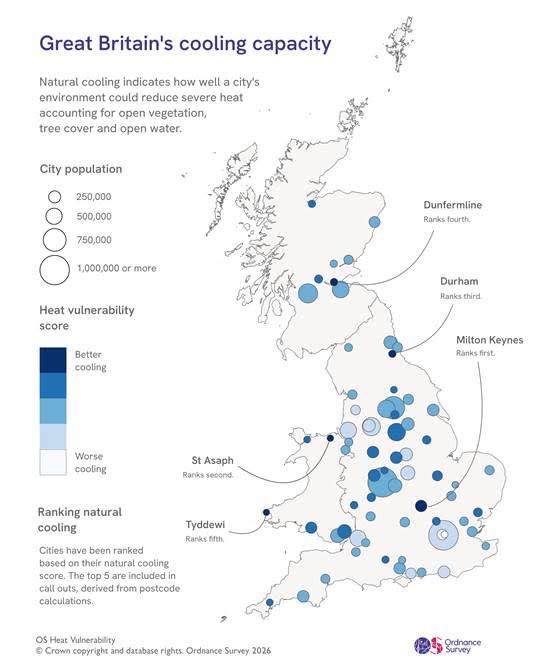
The index attributes much of the variation between cities to green and blue infrastructure. Milton Keynes, ranked 69th of 71 cities for heat vulnerability today, has the lowest built-environment score and the most effective natural cooling in the analysis, with 46km2 of natural surfaces against almost 40km2 of hard surfacing. Even so, the city is projected to move from moderate to high vulnerability by 2040.
Preston, London, Portsmouth, Westminster and the City of London recorded the least effective natural cooling of the 71 cities assessed.
Where new homes go
OS said the data was intended to inform decisions on where the government’s planned 1.5m new homes should be located, and where investment in green space and cooling infrastructure should be targeted.
Jonathan Hendry, chief executive officer at 4 Earth Intelligence, said exposure to heat could vary sharply within a single city:
“Cities are on the front lines of climate change, and while the challenge is global its impacts are often hyper-local,” he said. “Exposure can vary street by street within a single city, and the areas consistently subjected to higher temperatures than their surroundings are the ones that overheat first during a heatwave.”
He added that combining earth observation data with artificial intelligence made it possible to map risk “down to street level, supporting decisions on where heat refuges are sited and how emergency responses are planned in advance rather than in the middle of climate events”.
Nick Bolton, chief executive officer at Ordnance Survey, said: “These findings matter because cities are where millions of people live, work and spend their everyday lives. Extreme and sustained heat can affect people’s health and wellbeing, how comfortable our homes and workplaces are, and put additional pressure on transport, energy and emergency services.
“Understanding how and where this vulnerability is changing depends on an accurate view of how the country is built, based on trusted authoritative data, which is critical for planners, developers and local authorities preparing for a warmer future.”
Image credit: Roman Bodnarchuk/Shutterstock
Read next: Time capsule sealed at Croydon development
Are you a social housing professional? Sign up for a FREE MEMBERSHIP to upload news stories, post job vacancies, and connect with colleagues on our secure social feed.
